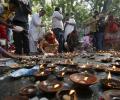
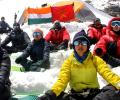
'We know the situation has worsened in the valley, but we are taking the first step.' 'We have lost 30 years of our life. We do not want to wait any longer.' 'The political class always said, you come down to Kashmir.' 'So, we are going to be there and we are going to demand a place to stay.' 'After all, it is our own land.'

In any controversy, the participants cannot decide who is right or wrong. A democracy has a process in place to settle these disputes: the judiciary. Dinanath Batra in true democratic fashion availed of that opportunity citizen and Penguin's decision was the outcome of a legitimate legal battle, says Vivek Gumaste.

'Dalits will only suffer in the days to come.'

'Gandhi turned his life into a counter-intuitive experiment in old ideas like non-violence and swadeshi.' 'He offered numerous universal ideas that talk to the human condition.' 'His ability to take risks was outstanding,' says Sopan Joshi, explaining why the Mahatma's ideas are as relevant as ever.

'It is vital that objects such as the Harihara -- and collections from South Asia generally -- remain here,' the British Museum tells Vaihayasi Pande Daniel.

Twenty years after the demolition of the Babri Masjid, India is in rebirth mode. Whether there is a Babri Masjid or a Ram temple or not in Ayodhya, India will go on. And it will see many tomorrows, says Syed Firdaus Ashraf.

After last week's acquittal of 16 policemen, pointedly accused of the cold-blooded murder of 42 Muslims in Meerut in 1987, this mohalla in Meerut is still scarred by the past but willing to move on
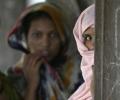
The families that were affected by the communal violence in Muzaffarnagar district have no hope of their homes being restored to them. Is the government really unable to reassure them of a safe return?

The Deen Bachao, Desh Bachao conference in Patna on April 15 was attended by lakhs of Muslims. Will the electoral dividends from this rally be reaped by Nitish Kumar, the BJP (through Hindu consolidation), by both Nitish and the BJP or will it be reaped more by the anti-BJP forces, asks Mohammad Sajjad.

'Pluralism is a fundamental fact of Indian life,' Colonel Anil A Athale (retd) tells members of the US Congress. 'Indians created a secular/plural State because that is what the majority believes in and not the other way round.'
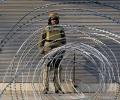
My travels made me realise how different the ground situation and people's mindsets in the two states are. People seemed happy and secure in Tripura whilst there was only complaining and suspicion in J&K, says Sanjeev Nayyar.
Today, it is modish to be part of a yoga class, to post stories on Instagram while striking an impressively complex asana in a bralette and crop-top paired with neon yoga pants, to bond over green tea and yoga bars after a strenuous session at the studio and have subscriptions to yoga studios, not ashrams, says Manavi Kapur.

It's difficult to say who suffered more these 28 years: The men who survived the PAC shooting and the assaults in jail; or the women who lost their men in these custodial killings.
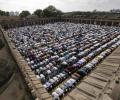
'One can understand this prejudice in the minds of policemen against Muslims, without accepting it. But what tilts the balance disproportionately is the police's blind eye to offences committed in the name of the majority.' says Jyoti Punwani.

'It would be a folly on our part to believe that the KKK or its Indian version exists only as some dedicated organisation. Rather, the Indian KKK, much like the American counterpart, exists as a fragmented and amorphous collection of independent groups and individuals,' says Shehzad Poonawalla.

If doing business in India is a problem for even the richest, most educated scion of a business house, it is unlikely to be a breeze for the average rural Indian woman.

'Smita Patil was the reason I got into films. She kept telling me to get into films but I said I was happy doing theatre, I don't like films. Today, when I look back, I don't think I disliked films. Maybe I thought who would take me in films? I think it was a complex.' Nana Patekar looks back at his life.

'Consider this image of today's youth in Bihar -- armed with a bike, a smartphone and possibly some illegal arms too, imbibing incessant stream of images from the Internet and television.' 'Some of them would turn into gau bhakts, some would listen with interest the exploits of Salafism, dig deep into the Internet to come out with images which cry vociferously that their respective religions are in danger.'

'It was a mission undertaken in darkness in every sense -- literally, because Afghanistan had no electricity at that time; and, metaphorically because Delhi historically dealt only with the Pashtuns of Afghanistan and the foreign ministry's vast archives had nothing to offer on the culture and politics of the northern tribes in the Hindu Kush.'

'In Hindu society, marriage is not between a man and a woman, but between their castes; politicians do not ask for human votes, but for caste votes....' 'Have you heard of such nonsense anywhere else in the world? And we claim we are civilised!' 'One or two or a few people becoming President, Prime Minister, Chief Minister, Speaker etc from the downtrodden do not mean that the untouchables are uplifted and caste-based slavery is over.'

'The Indian government has accepted and is a party to international agreements, standards and conventions on religious freedom.' 'We did not force it on them. We are not trying to impose something on them that they haven't already agreed to...' 'India has never allowed us to visit, which is very disappointing for such a wonderful country with such a rich democratic tradition. They seem to be afraid to let us in.'

Rediff.com reproduces the 1997 feature about Laxman, his passion for crows, and of course, his genius.
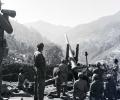
Fifty years ago, India and Pakistan fought a short but bloody war. The author finds out how Sainik Samachar, the defence ministry's journal, reported it.
